
Getting therapy in the UK sounds straightforward until you actually try. Suddenly you're navigating NHS waiting lists, wondering whether you need a GP, and second-guessing whether the therapist you found online is even qualified. It's a lot. The good news is that the referral process is far more manageable once you understand the different pathways available to you. This guide walks you through everything: who can self-refer, what to prepare, how to move through each step, what to do when things go wrong, and how to verify that the person you're trusting with your mental health is properly accredited.
Table of Contents
- Understanding therapy referral pathways in the UK
- What you need before making a therapy referral
- How to make a successful therapy referral step-by-step
- Troubleshooting and what to do if your referral is unsuccessful
- Verifying practitioner credentials and finding quality therapy
- Why many referrals fail—and what really helps
- Find trusted therapy support with Everything Healthcare
- Frequently asked questions
Key Takeaways
| Point | Details |
|---|---|
| Self-referral eligibility | Adults can usually self-refer for NHS Talking Therapies but other services may require a GP referral. |
| Be prepared | Gather key personal details and clarify your needs to speed up the referral process. |
| Check accreditation | Always verify your therapist’s registration with PSA-accredited professional bodies. |
| Act on delays | If you face referral problems or delays, alternative pathways and appeals are available. |
Understanding therapy referral pathways in the UK
The UK has two main routes into therapy: NHS and private. Each works differently, and knowing which one applies to your situation saves a great deal of time and frustration.
NHS Talking Therapies is the most accessible starting point for many adults. Adults aged 18+ can self-refer to this service for anxiety and depression without needing a GP referral at all. You simply contact your local NHS Talking Therapies service directly, either online or by phone. However, conditions like eating disorders require a GP referral before you can access specialist support. The NHS pathway is free at the point of use, which makes it the first choice for many people.
For those under 18, the process is more structured. Young people typically access support through CAMHS (Child and Adolescent Mental Health Services), which requires a referral from a GP, school, or another healthcare professional. Self-referral is not generally available for under 18s in most regions.
Regional differences are worth noting. Scotland, Wales, and Northern Ireland each have their own mental health services that differ from the English NHS structure. In Scotland, for example, Primary Care Mental Health Teams operate alongside Talking Therapies equivalents. Always check your local health board's website for the most relevant information.
The private pathway is more flexible. You can contact a private therapist directly, without any referral at all. Some private practitioners work through insurers, which may require pre-authorisation, but most accept self-paying clients who simply book an appointment. Platforms that support private therapy registration can make this process considerably easier by connecting you with verified practitioners in your area.
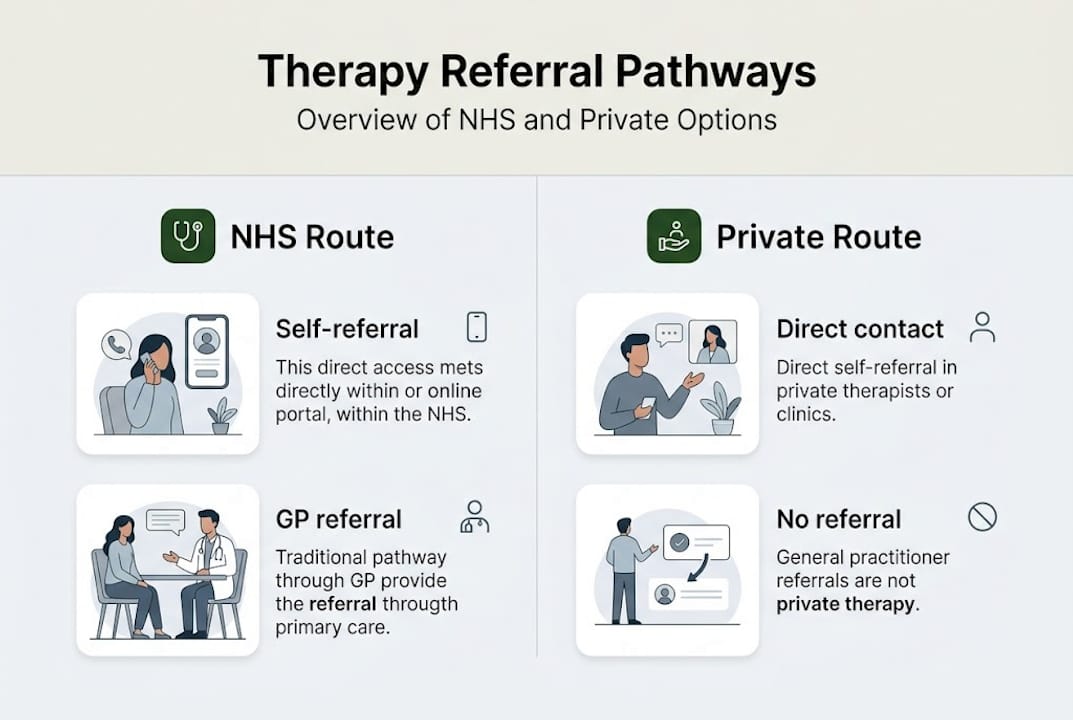
Here's a quick comparison of the two main routes:
| Feature | NHS Talking Therapies | Private therapy |
|---|---|---|
| Cost | Free | Paid per session |
| Self-referral (18+) | Yes (anxiety/depression) | Yes |
| GP referral needed | For complex conditions | Rarely |
| Waiting times | Weeks to months | Often within days |
| Under 18s | Via CAMHS/GP | Direct booking |
Key eligibility points at a glance:
- Adults aged 18 and over can self-refer for NHS Talking Therapies
- A GP referral is required for eating disorders, psychosis, and complex presentations
- Under 18s access therapy via GP, school, or CAMHS referrals
- Private therapy requires no referral in most cases
- Regional NHS structures vary across England, Scotland, Wales, and Northern Ireland
"The right pathway depends on your age, condition, and location. Starting with your local NHS Talking Therapies service or a verified private directory is almost always the most efficient first step."
What you need before making a therapy referral
Before you pick up the phone or fill in an online form, taking ten minutes to gather the right information will prevent unnecessary delays and make the whole process smoother.
For an NHS referral, you'll need to be registered with a GP to access NHS Talking Therapies. This is a firm requirement, not a formality. If you're not currently registered, do that first. You'll also want to have your NHS number to hand, your GP's name and surgery address, and a clear summary of your symptoms including how long you've been experiencing them.
Thinking about your therapy goals before you refer is genuinely useful. Services often ask what you're hoping to get from therapy. Vague answers like "I just want to feel better" are understandable, but being specific, such as "I want to manage panic attacks at work" or "I'm struggling with low mood after a bereavement", helps the service match you to the right support faster.

For parents or carers referring a child, additional information is required. You'll need the child's NHS number, school contact details, and in many cases a letter or referral from the school's SENCO (Special Educational Needs Coordinator) or a GP. CAMHS referrals often require evidence that other support has already been attempted.
Common mistakes that slow things down:
- Not being registered with a GP before attempting an NHS self-referral
- Describing symptoms too vaguely on intake forms
- Forgetting to include contact details or availability
- Applying to the wrong service for your region or age group
- Missing required supporting documents for under 18s
Pro Tip: Write a brief symptom diary covering the past two to four weeks before you refer. Note how often symptoms occur, what triggers them, and how they affect your daily life. This makes your referral far more compelling and helps clinicians triage you accurately.
Private referrals are less paperwork-heavy, but it still helps to know what you're looking for. Think about whether you want in-person or online sessions, how frequently you can commit, and whether you have a preference for a particular therapeutic approach such as CBT (Cognitive Behavioural Therapy) or person-centred counselling.
How to make a successful therapy referral step-by-step
With your details ready, here is how to move through the process for each main pathway.
For NHS Talking Therapies:
- Visit the NHS website and search for your local Talking Therapies service by postcode
- Choose your preferred contact method: online self-referral form, phone, or in some areas a walk-in assessment
- Complete the form with your personal details, GP information, and symptom summary
- Submit and wait for confirmation, usually by email or post within a few days
- Attend an initial assessment call where a clinician determines the right level of support
- Begin treatment once a slot becomes available
The NHS waiting time target is 18 weeks from referral to treatment, though in practice the median wait is closer to 13 weeks. That's still a meaningful wait if you're struggling now, which is one reason many people pursue private therapy alongside or instead of the NHS route.
Pro Tip: After submitting your NHS referral, keep a note of your reference number and the date you submitted. If you haven't heard anything within two weeks, follow up directly with the service. Referrals do occasionally get lost in the system.
For private therapy:
- Use an accredited directory or verified platform to search for therapists in your area or online
- Check their credentials before making contact (more on this in the next section)
- Send an initial enquiry or book a consultation call to assess fit
- Confirm session frequency, cost, and cancellation policy before committing
- Complete any intake forms the therapist sends prior to your first session
| Step | NHS pathway | Private pathway |
|---|---|---|
| Initial contact | Online form or phone | Direct email or booking |
| Assessment | Clinician-led call | Therapist consultation |
| Wait time | Median 13 weeks | Often within 1 to 2 weeks |
| Cost | Free | Typically £50 to £120 per session |
| Credential check | Managed by NHS | Your responsibility |
Troubleshooting and what to do if your referral is unsuccessful
Even with a well-prepared referral, things don't always go smoothly. Knowing how to respond keeps you moving forward rather than stuck.
The most common reason referrals are declined is a mismatch between the service and the presenting condition. NHS Talking Therapies, for example, is designed for mild to moderate anxiety and depression. If your needs are more complex, you may be redirected to a different service rather than rejected outright. This isn't a failure; it's the system trying to match you to more appropriate care.
For children and young people, the picture is more difficult. Roughly 25% of under 18s referrals to CAMHS are unsuccessful due to criteria mismatch or process issues. This is a significant problem, and it often leaves families feeling dismissed. If a CAMHS referral is declined, ask the referring professional for written feedback explaining why, and request information about alternative services.
What to do if your referral doesn't progress:
- Ask for written confirmation of the decision and the reason
- Request a re-referral if your circumstances have changed or new information is available
- Ask your GP about alternative NHS services such as community mental health teams
- Consider a private assessment to get a clearer clinical picture, which can support a future NHS referral
- Contact your local PALS (Patient Advice and Liaison Service) if you feel the decision was unfair
"A declined referral is not a closed door. It is often a redirection. Push for clarity on why, and use that information to find the right service."
For parents navigating a rejected CAMHS referral, school-based counselling, charity-run services like Young Minds, and private child psychologists are all viable alternatives while you pursue the NHS route.
Digital tools, standardised forms, and proactive communication between referrers and services all reduce the likelihood of an unsuccessful outcome. If you're making a private referral, clear communication from the outset about your needs and expectations sets a much better foundation.
Verifying practitioner credentials and finding quality therapy
Once your referral is progressing, whether through the NHS or privately, verifying your therapist's credentials is not optional. It is essential.
In the UK, the therapy profession is not statutorily regulated in the same way as medicine or nursing. This means anyone can technically call themselves a therapist. The safeguard is voluntary registration with a PSA-accredited (Professional Standards Authority) body. Private therapists should be registered with bodies like BACP, UKCP, or BABCP, all of which maintain searchable directories of accredited practitioners.
Here's what each body covers:
- BACP (British Association for Counselling and Psychotherapy): covers counsellors and psychotherapists
- UKCP (United Kingdom Council for Psychotherapy): covers psychotherapists and psychotherapeutic counsellors
- BABCP (British Association for Behavioural and Cognitive Psychotherapies): covers CBT practitioners
- BPS (British Psychological Society): covers psychologists
Red flags to watch for:
- No verifiable registration with a recognised body
- Reluctance to share qualifications or membership numbers
- Promises of guaranteed outcomes or rapid cures
- No clear cancellation or confidentiality policy
- Profiles only found on social media with no professional website or directory listing
Pro Tip: Always search the therapist's name directly on the relevant body's official directory rather than relying on their own claims. Membership can lapse, and an out-of-date certificate on a website tells you nothing about current standing. Platforms that connect you with accredited therapy directories do much of this vetting work for you.
NHS therapists are employed and credentialed through the health service itself, so credential checking is less of a concern on that pathway. For private therapy, the responsibility sits with you, and taking five minutes to verify registration is always worth it.
Why many referrals fail—and what really helps
Here's an uncomfortable truth: most referral failures in the UK are not caused by individuals doing something wrong. They're caused by a system that was not designed with the end user in mind.
Forms are inconsistent across regions. Eligibility criteria are written in clinical language that most people don't understand. Communication between GPs, CAMHS, and Talking Therapies services is fragmented. The result is that people who genuinely need support fall through the gaps, not because they didn't try, but because the system made it too difficult to succeed.
Standardised forms, digital streamlining, and early communication between referrers and services can meaningfully reduce unsuccessful referrals. We believe this strongly. The technology exists. The will to implement it is what's lacking.
What actually helps in the meantime is being proactive rather than passive. Follow up. Ask questions. Push for written explanations when things are declined. Use verified platforms that do the credential checking for you. The people who navigate this system most successfully are not the ones with the most clinical knowledge. They're the ones who treat the referral process like a project: organised, persistent, and clear about what they need.
Find trusted therapy support with Everything Healthcare
Navigating therapy referrals in the UK is genuinely complex, but you don't have to figure it out alone.
The Everything Healthcare platform connects you directly with verified, accredited practitioners across the UK, whether you're looking for a psychologist, counsellor, CBT therapist, or another mental health professional. Every practitioner on the platform holds active accreditation and valid insurance. Profiles that lapse are suspended automatically. No exceptions. If you're ready to take the next step, search for a verified therapist today and book with confidence, knowing the hard work of credential checking has already been done for you.
Frequently asked questions
Can I self-refer for therapy on the NHS?
Yes, adults aged 18+ can self-refer to NHS Talking Therapies for anxiety and depression without a GP referral, provided they are registered with a GP.
How long are NHS therapy waiting times?
The NHS waiting time target is 18 weeks from referral to treatment, though the median wait in practice is around 13 weeks.
Do children need a GP referral for therapy?
Under 18s typically access therapy via a GP, school, or CAMHS referral, and self-referral is generally not available for this age group.
How can I check if a therapist is properly accredited?
Search for your therapist on the official directory of a PSA-accredited body such as BACP, UKCP, or BABCP to confirm their current registration status.